

The idea of giving children a financial headstart began with the One Big Beautiful Bill Act (OBBBA), which first introduced government-funded investment accounts for kids. Trump Accounts were designed to help children start saving and investing even earlier.
At first glance, the idea is compelling. An account that begins growing from day one can give a meaningful advantage over time. But as with most financial strategies, the details matter, especially for families in California.
The program is now beginning to roll out nationally. Families who have already enrolled can begin activating their accounts through the new Trump Accounts app, developed by Bank of New York Mellon and Robinhood.1 The app is expected to be available through both the Apple and Google app stores, and families who have not yet enrolled can do so through TrumpAccounts.gov.2
Although account activation is beginning now, accounts officially open on July 4, 2026 when funding and the first federal seed contributions become available.3 In the meantime, families will also have access to educational resources focused on financial literacy and investing.
One of the biggest draws is the initial funding opportunity. Eligible children born between 2025 and 2028 who are U.S. citizens with a Social Security number may receive a $1,000 federal contribution, which begins compounding immediately.4
Children under the age of 10 who do not qualify for the $1,000 government funding may be eligible for a $250 contribution funded by private sources, such as philanthropists Michael and Susan Dell.5 This $250 contribution is available to the first 25 million American children aged 10 and under, who live in ZIP codes with median household incomes below $150,000.6
Beyond the initial contribution, parents, grandparents, relatives, friends, or even employers may collectively contribute up to $5,000 annually per child.7 The app will also allow families to automate recurring contributions and project future account balances over time.
At launch, the default investment option will be an S&P 500 exchange-traded fund, with additional broad-based index investment options expected to become available later.
Even though these amounts may seem modest, the real advantage is time. Money invested early has decades to grow, which can make a meaningful difference over the long term.8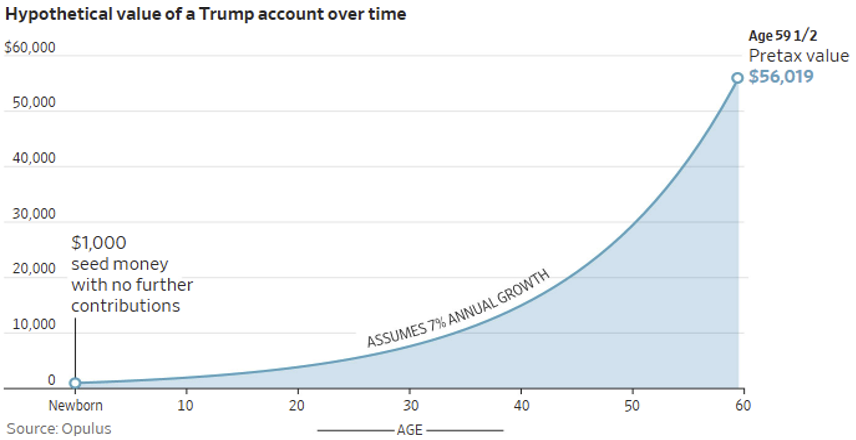
That said, this is where things become a bit more nuanced.
At the federal level, Trump Accounts offer tax-deferred growth, meaning investments can compound without annual taxation, similar to a traditional IRA.9
However, California does not conform to federal tax law.10 Instead, earnings are taxed each year at the state level, making the account function more like a taxable investment account locally.
For smaller amounts, like the initial $1,000 or $250, taxes aren’t a big deal. But as the account grows over time, the yearly taxes can eat into the earnings.
Because of this, Trump Accounts are often best viewed as a starting point rather than a complete solution.
This also does not need to be an all-or-nothing decision. Many families may find the most effective strategy is combining multiple planning tools. For example, families could capture the initial seed funding within a Trump Account while continuing to prioritize a 529 plan for long-term, tax-efficient education savings.
Children assume control of the account once they reach age 18. At that point, they may choose to continue investing or begin taking withdrawals under the rules that generally apply to traditional individual retirement accounts.
Initially, Trump Accounts will be managed exclusively through the app platform, though future rollovers to participating financial institutions are expected to become available over time.11
In the end, Trump Accounts reinforce an important financial principle: starting early matters.
For many families, the best strategy may be relatively simple: capture the available seed funding, then build around it with other long-term planning tools that may offer greater tax efficiency and flexibility.
If you’re curious about how Trump Accounts might fit into your family’s financial picture, or simply want to explore different ways to give your children a financial head start, please reach out to us to schedule a conversation about whether this strategy may be appropriate for your situation.
Trump Accounts Official Website: https://trumpaccounts.gov/
1 (The Wall Street Journal, 2026)
2 (The Wall Street Journal, 2026)
3 (The Wall Street Journal, 2026)
4 (IRS, 2026)
5 (CNBC, 2025)
6 (The White House, 2025)
7 (Official Trump Accounts Website, 2026)
8 (The Wall Street Journal, 2026)
9 (CNBC, 2026)
10 (State of California, Franchise Tax Board, 2026)
11 (The Wall Street Journal, 2026)